 Michael Seymour
Podean named winner of Global Expansion Award presented by Amazon Ads 2023 Partner Awards
Podean was awarded the 2023 Global Expansion Award by Amazon Ads for its work expanding e.l.f. Cosmetics into two new markets. The award was received...

Black Friday through Cyber Monday 2026 runs November 27 to 30, and we project the market will grow approximately 7.5% across 11 Amazon marketplaces. While that’s a healthy overall projection, the performance varies considerably by country. The US is expected to account for much of the growth, largely driven by higher prices, Europe is expected to be relatively flat, and several other markets are projected to grow at double-digit rates.
Our BFCM 2026 Market Outlook combines published third-party projections with Podean Intelligence, which incorporates how brands in our portfolio have performed across each country this year. We’ve used that data to develop our expectations for BFCM and identify where brands should be focusing their budgets, promotional strategies, and inventory.
Our global market projection is +7.5%, with a low case of +6.5% and a high case of +8.6%. However, when you remove the US, the other 10 countries are projected to grow just +4.2%. This is an important distinction for brands operating internationally, as the global average doesn’t necessarily reflect the growth opportunity in individual markets. Using that average to guide investment decisions could result in advertising and promotional budgets being allocated inefficiently.
Based on performance across our client portfolio, we expect Podean-managed brands to outperform the market, with a midpoint of +8.3% and a range of +7.1% to +9.5%.
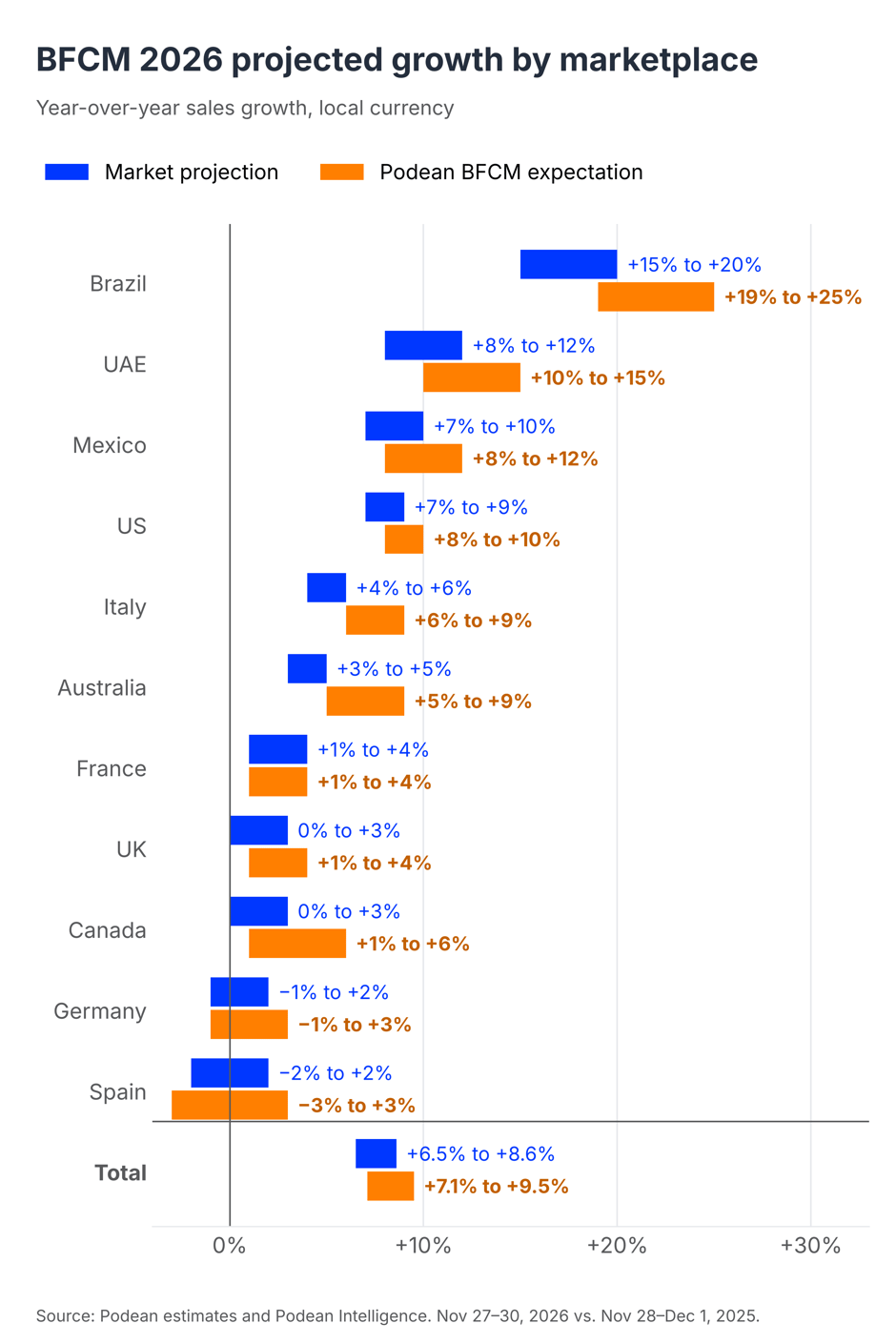
Brazil has the strongest growth outlook, with the UAE and Mexico also expected to deliver double-digit or near-double-digit growth. The US remains a relatively strong market at +7% to +9%. Performance across the more mature European markets is considerably softer, with most expected to deliver low single-digit growth and Germany and Spain both carrying the possibility of declining sales year over year.
The US is projected to grow +7% to +9%, but roughly half of that growth is expected to come from higher prices. When looking at unit volume, actual growth is closer to +3% to +4%.
This is worth considering when evaluating individual brand performance. A brand reporting 7% revenue growth this BFCM may not actually be gaining market share, particularly if its growth is largely coming from higher average selling prices. Similarly, brands reporting flat revenue could be experiencing declines in unit volume.
For brands evaluating their BFCM results, it’s important to look beyond revenue and understand how much of the growth is coming from pricing versus actual demand. Otherwise, it’s easy to overestimate performance relative to the market.
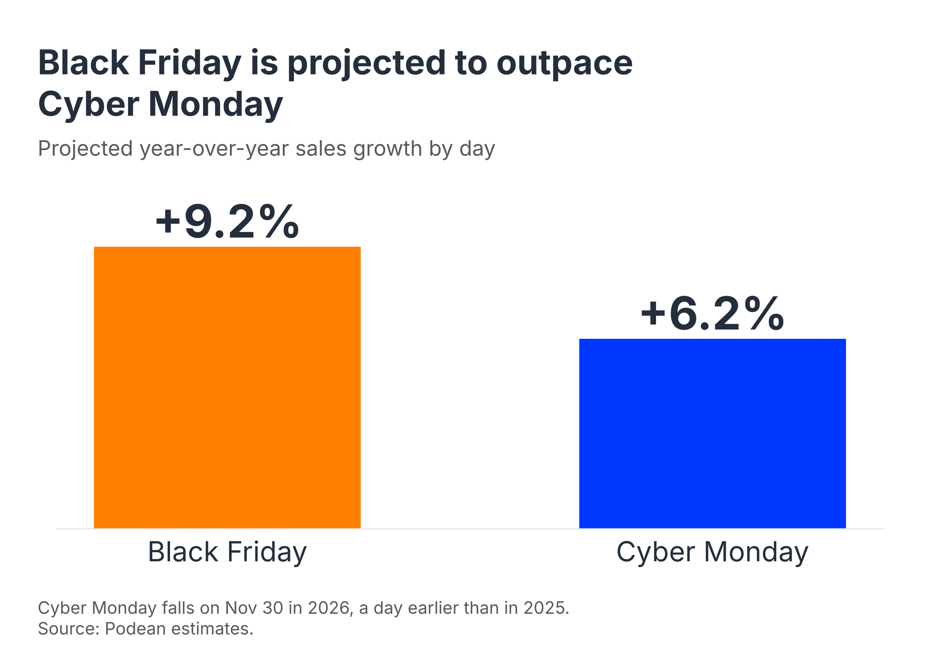
Black Friday is projected to grow +9.2%, compared to +6.2% for Cyber Monday. The calendar also contributes to the difference this year, with Cyber Monday falling on November 30, a day earlier than in 2025.
The projections suggest that more of the sales opportunity will be concentrated earlier in the event, particularly from Thanksgiving through Black Friday. Brands should take this into account when planning advertising budgets, promotional offers, and inventory availability. Historically, many brands have put considerable emphasis on Cyber Monday, but the expected growth rates suggest that doing so could mean underinvesting in the earlier part of the event.
The UK, Germany, France, and Spain are all projected to be relatively flat, with Germany and Spain potentially declining year over year. This creates a more challenging environment for brands looking to grow, particularly when compared with markets such as Brazil, Mexico, and the UAE.
In markets with limited overall growth, gaining market share generally requires taking sales from competitors rather than benefiting from an expanding category or marketplace. We expect this to put additional pressure on advertising efficiency, as brands compete for a relatively stable pool of demand.
Brands operating in these markets should be realistic about their growth expectations and consider how much additional advertising investment will be required to generate incremental sales. In some cases, maintaining market share and improving profitability may be more appropriate objectives than pursuing aggressive revenue growth.
Category performance also varies considerably, with grocery and household essentials, beauty, and toys showing some of the strongest growth expectations. Current shopping trends suggest consumers are using the promotional period to stock up on everyday products while also taking advantage of discounts in categories such as beauty and toys.
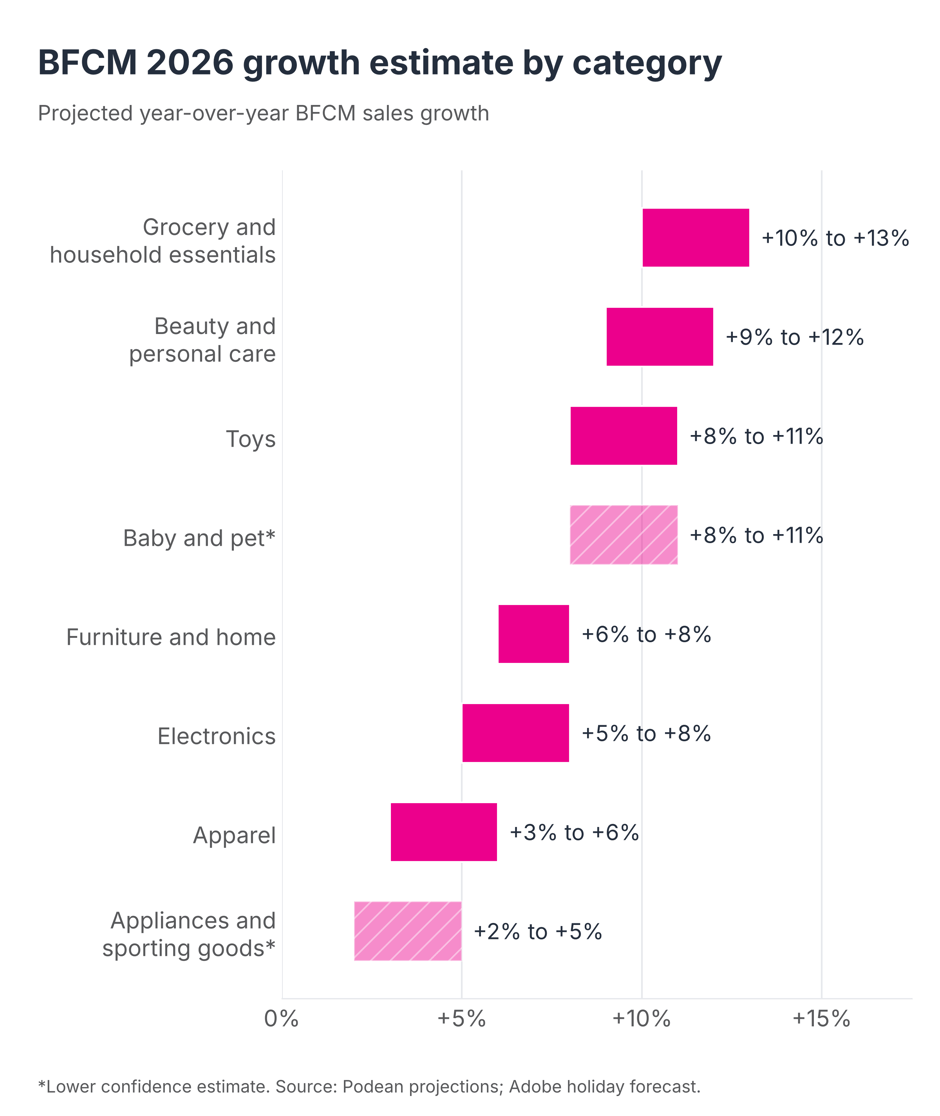
*Lower confidence estimate.
Electronics remains the largest category, although much of its projected growth is expected to come from pricing, with unit volume remaining flat to down. Apparel is projected to be the weakest of the major categories.
For brands operating in essentials, beauty, toys, baby, and pet, the stronger demand outlook makes inventory planning particularly important. For electronics and apparel, where the growth opportunity is more limited, promotional strategy and advertising efficiency will likely have a greater impact on results.
There are a few areas where I think brands should be adjusting their BFCM plans based on these projections.
Advertising and promotional budgets should reflect the timing of demand. With Black Friday projected to outperform Cyber Monday, brands should consider shifting more of their investment and promotional activity toward the earlier part of the event. This doesn’t necessarily mean reducing Cyber Monday investment, but the allocation should reflect where the stronger growth is expected.
Revenue shouldn’t be the only measure of performance. With higher prices accounting for roughly half of US market growth, revenue increases can make performance look stronger than it actually is. Brands should be monitoring unit volume and market share alongside sales to understand whether they’re generating incremental demand or simply benefiting from higher average selling prices.
International investment needs to reflect individual market conditions. The growth opportunity in Brazil, the UAE, and Mexico looks very different from what we’re projecting in the UK, Germany, France, and Spain. Brands should be setting market-specific growth targets and adjusting advertising investment accordingly rather than applying the same expectations across all international marketplaces.
Promotional strategies should vary by category. Essentials, beauty, toys, baby, and pet are showing stronger demand signals, which makes inventory availability and promotional execution particularly important. In electronics and apparel, where growth is expected to be more limited, brands will need to be more deliberate about discount depth and media efficiency to drive incremental sales.
The projections highlight how much performance is likely to vary across Amazon’s 11 major marketplaces. While the overall market is expected to grow +7.5%, that number masks significant differences in both geographic and category-level performance.
For brands selling across multiple marketplaces, the challenge is understanding where the growth is coming from and making sure their investments reflect those differences. A strategy that works in the US may not translate to Germany, just as promotional strategies that work in beauty may not deliver the same results in electronics.
This is where combining global marketplace data with an understanding of local market conditions becomes important. At Podean, we work with brands to bring together media, content, and retail strategies across marketplaces, using performance data and local market intelligence to guide investment decisions.
Want to see how your category and markets compare with these projections? Get in touch with our team.
Growth compares November 27 to 30, 2026 with November 28 to December 1, 2025, in local currency. Market projections are Podean estimates built from published 2026 forecasts, including Adobe, Bain & Company, Mastercard SpendingPulse, NRF and local sources in each country. Germany, France and the UAE had no published 2026 figure, so those rely on 2025 actuals and survey signals.
The Podean expectation scales each market projection by a conservative uplift based on client performance in that country in 2026. Category season growth is from Adobe’s holiday forecast; BFCM category estimates are Podean projections.

Podean was awarded the 2023 Global Expansion Award by Amazon Ads for its work expanding e.l.f. Cosmetics into two new markets. The award was received...

Amazon Explained - The Flywheel - Podean's Amazon Explained Series delivers insights into the drivers of Amazon's success.

unBoxed 2023 is officially underway and what an exciting day it has been! The Podean team will be recapping each day's big moments, and why they...